History and Timeline of the Ontario Community Infrastructure Fund
The Ontario Community Infrastructure Fund (OCIF) was announced in 2014 to support core infrastructure needs in small, rural and northern municipalities. The program was initially designed to provide $100 million annually for local road, bridge, water and wastewater projects. At the time, half of the funding was distributed through a formula-based allocation, intended to reflect differences in municipal infrastructure and fiscal needs, while the remaining $50 million was delivered through an application-based stream. Eligibility was focused on municipalities with populations under 100,000, as well as municipalities located in northern or rural Ontario.
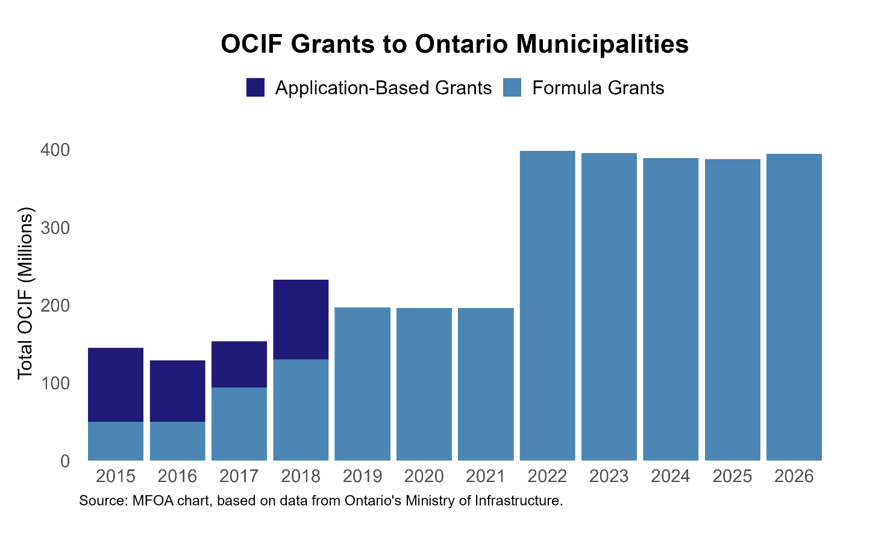
OCIF was later expanded through the 2016 Ontario Budget, which committed to increasing the program to $300 million annually by 2018–19 to further support infrastructure projects in small, rural and northern communities. Under this expanded structure, formula-based funding increased to $200 million annually, while the application-based stream was expected to increase to $100 million annually. However, in 2019, the Province indicated that fiscal circumstances prevented the full expansion of OCIF, resulting in the cancellation of the top-up application component, while maintaining the increase in formula-based funding to $200 million for that year.
In 2021, the Province announced a further expansion of OCIF through the Fall Economic Statement, committing an additional $1 billion over five years. This brought the total OCIF investment to nearly $2 billion over the 2022-2026 period, or about $400 million per year. Beginning in 2022, allocations continued to be based on a formula recognizing the different needs and economic conditions of communities across Ontario, with the minimum annual allocation increasing from $50,000 to $100,000 per community.
Starting with the 2023 allocations, the Ministry of Infrastructure (MOI) updated the OCIF formula to incorporate current replacement values for eligible core infrastructure, shifting from the use of historic cost data to CRVs. A municipality’s core infrastructure was calculated using either asset management plan CRV estimates or MOI’s CRV estimates for eligible core infrastructure categories. Starting with the 2024 OCIF cycle, the Ministry introduced a standardized Excel-based CRV template to collect municipal CRV data more consistently, building on the initial 2023 shift from historic cost data to current replacement values. A smoothing mechanism was also implemented to generally limit changes in 2023 funding to within ±15 percent of prior year’s allocations.
In 2026, 423 small, rural and northern communities across Ontario are receiving approximately $400 million in OCIF funding to renew and rehabilitate critical infrastructure. Starting this year, the minimum grant amount has increased from $100,000 to $125,000. The smoothing mechanism has also been adjusted, generally limiting year-over-year changes in 2026 allocations to within ±10 percent of 2025 grants. However, as 2026 is the final year of the current five-year funding commitment, municipalities are seeking greater clarity on the future of the program.
The graph below shows annual OCIF grants to Ontario municipalities from 2015 to 2026, including both formula-based and application-based grants where applicable. Totals are based on actual approved yearly grants from MOI data and may not fully match announced OCIF allocation amounts.